
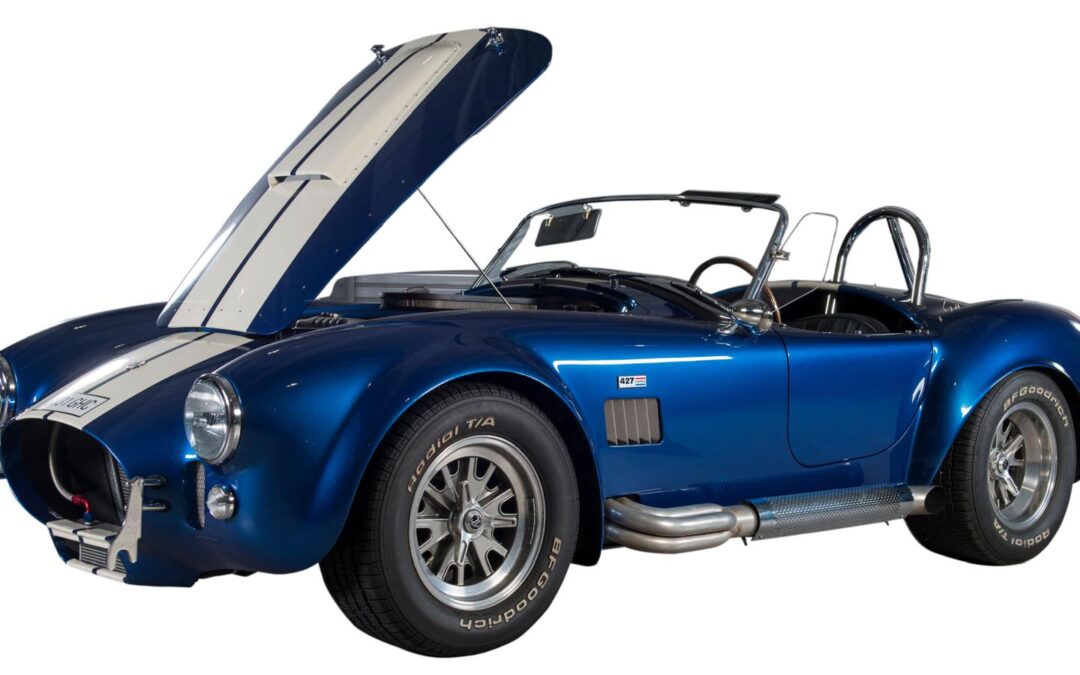
The Shelby Cobra 427 occupies a singular place in automotive history. It was not the product of a marketing study, nor the result of a polished brief. It was born from a radical idea: pairing a lightweight, proven British chassis with a large-displacement American V8 engine — without trying to smooth out the character of the result.
The outcome is a direct, demanding car, built at a time when compromise was not a central concern.
An atypical genesis
In the early 1960s, Carroll Shelby identified the potential of the AC Ace chassis, but felt its engine lacked character. The integration of a Ford V8 fundamentally transformed the project. With the 427 version, the Cobra reached its most extreme expression: wider, more powerful, more physical.
Between 1965 and 1966, approximately 300 MK III examples were delivered to Shelby, including versions intended for motorsport use. While this generation was not officially homologated for racing in 1965, it later distinguished itself in private competitions, particularly during the 1970s. These so-called semi-competition versions are today among the most sought-after Cobras by collectors.
A car apart
The Cobra 427 conforms to no modern standard. It offers neither electronic assistance nor superfluous comfort. Driving it relies entirely on mechanical feel, torque management and respect for the machine. It is precisely this absence of filter that explains its status as an enduring icon.
Beyond the figures, the Cobra is above all an experience: a car driven with attention, one that demands genuine commitment and speaks to enthusiasts who know exactly what they are looking for.
A measured reading of the market
Today, the Cobra 427 market is mature and selective. Value gaps between examples are significant and depend essentially on build quality, historical consistency and restoration level. Informed buyers favour documented, sound cars faithful to the original spirit, rather than approximate interpretations.
In this context, the Cobra remains a sound choice for lovers of characterful vehicles — provided they understand its specificities.
Conclusion
The Shelby / AC Cobra 427 is not a consensual car. It seeks neither to reassure nor to appeal to the widest audience. It embodies a vision of the automobile where mechanics take precedence over discourse, and where emotion is born from the sincerity of the concept.
And as it happens — this month, Classic Vintage Car is not offering one AC for sale, nor two… but three emblematic models:
- a Cobra 427,
- a Cobra 289,
- and an AC Bristol.
Three different interpretations of the same DNA, each with its own personality and history.
An unconventional origin
In the early 1960s, Carroll Shelby identified the potential of the AC Ace chassis but found its original engine lacking in character. The integration of a Ford V8 fundamentally transformed the project. With the 427 version, the Cobra reached its most extreme expression: wider, more powerful, and physically more demanding.
Between 1965 and 1966, approximately 300 MK III Cobras were delivered to Shelby, including cars intended for competition use. Although this generation was not officially homologated for racing in 1965, it later proved highly competitive in private racing series, particularly during the 1970s. These so-called semi-competition (S/C) cars are today among the most sought-after Cobras, commanding multi-million valuations at the top end of the market.
A car apart from modern standards
The Cobra 427 does not conform to any modern benchmark.
There are no electronic aids, no artificial filters, and no unnecessary comforts. Driving relies entirely on mechanical feedback, torque management, and respect for the machine. It is precisely this absence of mediation that has secured the Cobra’s enduring iconic status.
Beyond figures and specifications, the Cobra is above all an experience. It demands involvement, attention, and a clear understanding of what it represents. This is not a car that flatters its driver—it challenges them.